Search here
 Log In
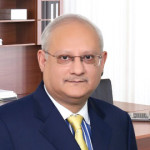
MD, Karachi Stock Exchange (KSE)
CV:
Mr. Nadeem Naqvi holds the degrees of M.B.A. in Finance and B.Sc. with Honors in Banking and International Finance from The City University, CASS Business School in London, United Kingdom. He has over 31 years of rich work experience in the global financial services industry, operating in diverse environments of the Middle East, North America and Europe besides that of Pakistan. Economic & market analysis and research has been the hallmark of Mr. Naqvi's career. He has led an independent investment research firm in USA/Canada, Investology Inc., which was ranked by 'Business Week' in 2004 as the third best out of 300 independent research firms in North America. Before that, he headed the Merrill Lynch Pakistan research team. He was also the Head of Research of the investment advisory company of Morgan Stanley Asset Management's Pakistan Investment Fund for four years. He commenced his career at the Bank of Credit & Commerce International S. A., in London in 1982.
Blurb:
KSE has been amongst the top-10 best performing markets in the world for the last three years, according to Bloomberg. In US$ terms, market capitalization rose by 27.3%.
Evolve: Could you give us a bit of background about KSE and please also share that what is the role of Stock Exchange in the financial markets?
Nadeem Naqvi: The Karachi Stock Exchange or KSE is a most liquid stock exchange of Pakistan incorporated in 1949, with 560 Pakistani as well as foreign Multinationals listings.
KSE has been amongst the top-10 best performing markets in the world for the last three years, according to Bloomberg. In US$ terms, market capitalization rose by 27.3%. The average return on KSE 100 index in last 10 years is 25% compared with gold and on long term bank deposits are 15% and 12%, respectively.
KSE offers Companies and investors an efficient and transparent securities market for raising capital and achieving investment objectives. Companies listed on KSE are present in all aspects of our lives and are amongst Pakistan’s most well known largest and most innovative companies. These Companies raise their capital for their business ventures through stock exchanges, investors get opportunities to invest for profit in businesses directly through Initial public offering, book building or through stock brokers, mutual funds, etc.
Businesses find it difficult to get longer term loans from banks and also banks ask for want collateral / guarantees before they lend and charge mark up / interest whether the business earns profit or not.
Listed companies enjoy higher esteem in the eyes of its debtors and creditors because of the availability of their financial statements for general public and are closely monitored by the regulators.
From 2002 to 2014, PKR1.1trillion in equity and debt capital has been raised from the stock market by corporate sector. Government of Pakistan has also risen around PKR 316 billion through privatization.
Evolve: How active are foreign investors in your exchange? How accessible is your market?
Nadeem Naqvi: Foreign buying interest had been very active on the KSE. According to State Bank of Pakistan weekly position report of August 31, 2015, foreign investment in capital markets totals about US$6.8 billion including sponsors’ capital in multinationals subsidiaries registered domestically.
Evolve: What new project/product are you currently working on?
Nadeem Naqvi: KSE remains the pioneer of Pakistan’s capital market development by introducing new products to investors through a state of the art technology infrastructure. Market participants (local and international) are provided access to these products through various distribution channels of the brokerage houses. Presently the Trading products include Equities (known as Ready Market), Deliverable Futures Contracts, Cash Settled Futures Contracts, Stock Index Futures Contracts and Bond Automated Trading System. KSE also offers data products and services by providing data feed to its local and foreign customers. KSE plans on introducing Small and Medium Enterprises (SME’s), Market segment Index based options, Exchange Traded Fund (ETF’s), as well as cross border listings of companies and indices.
KSE and SECP are in advanced stages of discussion with M/s Al-Meezan Funds and M/s MCB Arif Habib to launch Exchange Traded Funds at Karachi Stock Exchange, out of the three ETFs in pipeline, two are expected to be launched by June 2016.
Evolve: What are the challenges you see in your market today and in the future?
Nadeem Naqvi: The biggest challenge facing KSE is enhancing liquidity and volumes. The Management remains focused on working with all stakeholders so that this issue is tackled.
Evolve: What are some of the major milestones over the last few years that have really made the KSE a competitor on equal footing to the other exchanges?
Nadeem Naqvi: The stock exchanges of Pakistan were previously operating as non-profit companies with a mutualized structure wherein members had ownership as well as trading rights. This structure created potential for conflict of interest as members predominantly controlled affairs of stock exchanges which was not conducive for appropriate corporate governance in a self-regulatory organization.
Corporatization and Demutualization of stock exchanges entailed converting their structure from non-profit, mutually owned organization to for-profit entities owned by shareholders. The enactment of Stock Exchanges (Corporatization, Demutualization & Integration) Act, 2012 ("Act") has brought Pakistan's capital market at par with other international jurisdictions such as India, Malaysia, Singapore, USA, UK, Germany, Australia, Hong Kong and Turkey, among others. It has provided a framework for corporatization, demutualization and integration of stock exchanges. The demutualization of stock exchanges is expected to result in expanding market outreach, attracting new investors, improving liquidity and enabling the stock exchanges to attract international strategic partners. It should also facilitate consolidation of brokers (TREC Holder) leading to financially strong entities.
KSE signed an MOU with Boursa Istanbul in January 2015 through which the exchanges will share information and expertise in various fields with a view to building a long-term relationship. The parties also agreed to seek possible ways on cooperation for cross border listing, portfolio investment, corporate bond market, commodity market and development of new capital market instruments. Borsa İstanbul informed that they are ready to provide expertise for further development of the capital market in Pakistan through this MoU which will boost collaboration in various aspects of exchange business.
Evolve: How do you assess your exchange’s position at a time of increased globalization?
Nadeem Naqvi: On the international front Global X Fund, a US based provider of ETFs, has launched a Pakistan based Exchange Traded Fund at NYSE with effect from 23rd of April. This would provide an important exposure to Pakistan’s Capital Markets in the global financial center and would also provide familiarity with major sectors and stocks to the world’s largest institutional investors.
Evolve: Is Karachi Stock Exchange looking for any tie-ups in emerging markets?
Nadeem Naqvi: For Pakistan to be counted among the emerging markets of the world in tandem with the global trend towards consolidation, integration and demutualization of stock exchanges, a strategy has been adopted whereby the Karachi, Lahore and Islamabad exchanges are being integrated into a national bourse under the nomenclature of “Pakistan Stock Exchange”. The integration is expected to help reduce market fragmentation and create a strong case for attracting strategic partnerships necessary for providing technological expertise and new products.
Evolve: How much have you been investing in technology?
Nadeem Naqvi: KSE continues to invest heavily in the world’s top class IT systems. Its Datacenter houses cutting-edge technologies including high-end servers, enterprise Storage sub-systems and state-of-art air purification and environment control systems.
KSE has examined the technical requirements that its next-generation backbone network should meet, including low latency transmission for high-speed system processing and business continuity.
After considering the network technologies needed for business continuity, high-speed systems processing, management of fault tolerance and low-latency, KSE adopted a robust network configuration which, inter-alia, includes superior connectivity option, optimized switching and superior network security.
KSE is amongst selected stock exchanges of the world which own the technology they use. All Mission-Critical Applications including Trading, Clearing, Settlement and Risk Management Applications are indigenously developed by following proper and well documented Software Development Life Cycle (SDLC).
Information security is a critical consideration at KSE. The information security processes and functions of the Karachi Stock Exchange work round the clock to detect intrusion and unprivileged access attempts to our computer systems and networks.
Evolve: Where do you see growth rate and interest rates going from here?
Nadeem Naqvi: Twelve months moving average inflation is at 3.6 percent and FY16 full year CPI is expected to be around 5 percent while the policy target rate is at 6.5 percent and the discount rate at 7 percent. The real interest rates are in the positive territory regardless of the definition.
The market was cautious last time for expected resurgence of inflation due to floods, big hike in utility prices (Gas) and possible northward movement of oil. However, none of these threats materialized and CPI averaged at 1.8 percent for Jul-August and it may remain below 2 percent for September as well.
Number of listed companies from cement, power, steel sectors have announced expansion plans whereas projects of coal and LNG are in pipeline. The rupee has depreciated by 2 percent last month due to pressure of steep fall in regional currencies. Any further depreciation of currency will increase inflation. There is another issue of the fall in banking deposits which could be due to low rates on deposits and the newly imposed tax on banking transactions.
The country's saving rates are too low and depositors ought to have some incentives to keep savings in banks, and further cut in rates may exacerbate the situation. It shall be noted that in Pakistan due to heavy regulation of prices and indirect taxation in key elements of CPI (such as agriculture support prices, utility and fuel prices), the inflation is more a cost push phenomenon rather than a demand-pull one. Even the small industrial base of the country is running below the full capacity. Further, with large segments of the economy being undocumented and thus cash driven and mortgage financing next to nothing the monetary transmission mechanism is weak. In such a situation the real beneficiary of lower interest rates is actually the government itself when it benefits from lower debt servicing costs. As far as the private sector is concerned, despite the discount rate having been reduced by over 300 basic points in the last year or so, private sector credit has shown little sign of growth.
Evolve: Any message for the readers of EVOLVE?
Nadeem Naqvi: In a situation of low interest rates and largely “regulated” inflation, it is important for individuals in particular to carefully asses their long term financial planning and savings strategy. Clearly, CPI inflation will not remain low in the medium term and the biggest threat to savings is inflation. Therefore savers should think carefully about their overall savings and investment portfolio. Historically, the long term average inflation rate in Pakistan has been near 8.% p.a. at the same time in the last 10 years, investment in shares of listed companies has provided an average return of more than 20% p.a., however returns have varied year to year. Thus the overall portfolio of long term investment/savings needs to provide a return of around 8% p.a. in order to the purchasing power of those savings/investments. This return requirement should be weighed against potential investment risk, liquidity needs of the saver for unforeseen emergencies, income level & savings rate possible as well as any tax benefits associated with various savings/investment schemes. It is a good idea to discuss the best approach with financial advisor/ tax accountant to develop a well thought out investment strategy.